Contents
- Editorial
- Letters to the Editor
- Contributions from Creative Writing Group
- By Cookery for Entertainment Group
- Apples! Apples! Apples!
- Freya's Well-Being Tips
- Train Adventures – Trip to Exmouth
- Knitting Group
- The Long Haul by Paul Dennison
- Our Committee (March 2025)
- About Torbay u3a
- Our Torbay u3a Facebook News
- Contributions from the Art Group
- Book Group No. 3
- Ancestors - the Torbay u3a Family History Group
- Interview with Peter Osborn by John Hough
- This is the third Torbay u3a Quarterly
Editorial
The Quarterly showcases the rich diversity of our special interest groups. It pays tribute to our Group Leaders who are the lifeblood of a u3a.

Autumn is a celebration of the harvest of local produce, illustrated by the apple pastry, described in the article by the ‘Cooking for Entertainment’ group. Our Practical Gardening Group has introduced a garden table at the Speaker’s meetings where members can share produce and plants for a small donation.
The content of The Quarterly is provided by individual members and guest contributors. It does not necessarily reflect the views of The Torbay u3a Committee or the Third Age Trust nationally.
I feel real momentum in our Torbay u3a, and this is reflected in the diverse contributions to this, the third issue of our Quarterly magazine. The expansion of the Quarterly is facilitated by the work of our Webmaster, Bob Hackwith, introducing a new structure that facilitates readers easily choosing what they read, what they skip over, and how much they read. Great work, Bob.
The contributions come from both members and Group Leaders, and we’ve had our first ‘Letter to the Editor’, a balanced comment on our bus services. Thankyou, Joanna. I hope your letter will encourage other members to email in. Maybe a reflection on ‘sitting’ with Agatha on the seafront’. Note: when I receive a contribution I do minimal editing, preferring the contributor to speak with their own voice.
In September I attended our first coffee morning for new members. Ten new members joined us and it was an invigorating meeting with lively discussion of our u3a. Several new members offered to take on organizational roles or to initiate and lead new groups. Wonderful how they embraced the u3a ethos of members giving and sharing what they can – for the well-being of the u3a.
I talk about the diversity of contributions. Let me highlight a few items.
- Paul Denison’s raw and honest poem on ‘living with Parkinsons’
- Audio interview with member, Peter Osborn, who joined the Royal Navy at age 16. (I’m looking to include such an interview on a regular basis. Let me know what you think about this. I’m still learning how to use the Audio/Video software – so quality is not the best. Please let me know if you have experience in this area or would like to learn with me)
- Article by the ‘Cooking for Entertainment’ group, who took advantage of the glut of local apples and have included recipes for their dishes. Would a reader like to provide a ‘Recipe Corner’ on a regular basis? Presenting recipes submitted by members.
I very much welcome Torbay u3a’s Facebook initiatives (Facebook Public Page and a private Facebook Group for members). The Quarterly will very much work with the Facebook team, enabling more dynamic communications between members, across groups and with the Torbay community.
On 18 September, in my role as Chair, I convened a meeting of the Chairs of 8 local u3as – Paignton, Livermead/Preston, Totnes, Teign(Newton Abbot), Teignmouth, Chudleigh, East Dartmoor and Torbay. It was an introductory meeting to explore how we might share experiences and work more closely together. We identified a number of areas that would benefit from cooperation including Publicity, Websites, BEACON (the new u3a Membership System). Susan Parker, one of two South/West Regional Councilors, joined us and encouraged our face-to-face meetings. We agreed to meet on a quarterly basis. Group Leaders: please let me know if you would like to see friendly competitions with other u3as.
It’s exciting times! Please share your ideas on developing our u3a further.
John Hough – Editor
**********
Letters to the Editor
Hi John
I much enjoyed the latest Quarterly, in particular the contributions from the Art Group, which were fabulous. As someone with no artistic talent I so admire anyone who can produce such lovely paintings.
You asked for feedback around bus services. I live quite close to Torbay Hospital so I can walk there without too much difficulty and I don’t really use taxis.
However I gave up my car a year ago this month and am now an enthusiastic bus user, in particular of services 12 and 35. I am lucky enough to live only 7 or 8 minutes away from the bus stop for both of these and use them all the time. I understand from Torbay Council’s newsletters that it is intended that Torbay’s buses will be all electric by summer 2026 and I am very excited about this prospect.
The 12 is a fantastic resource for all passengers between Newton Abbot and Brixham, although can be slow, especially in the summer traffic. The buses are modern, comfortable and relatively fast. (I have noticed that female drivers seem to be kinder to the passengers by not swerving manically around corners or screeching to a halt unnecessarily!)
The 35A and 35C buses are over 20 years old and it shows. They serve Torquay only between the harbourside and the Willows, including Watcombe/Barton/St Marychurch and Chelston/Shiphay. Often they are randomly cancelled. They certainly struggle to cope with the steep hills around Chelston and they occasionally break down. These particular buses offer a vital connection between the residents of the various districts and the town centre and with the hospital and are usually really busy.
If Stagecoach can replace these ancient vehicles with modern efficient electric buses these services will be transformed for the better. Perhaps we can even hope for a more frequent 35 service to serve Torquay’s residents - I do hope it happens!
Kind regards
Joanna
PS: I read a recent article describing Stagecoach’s planned investment in a fleet of electric buses. Go Torbay! Editor.
A brief History of Margarine
Whether you put butter, spread or marge on your bread is a personal choice, but have you ever wondered how that choice arose? Surprisingly, it was the result of Napoleon the third of France who, in 1869, offered a prize for the creation of a butter substitute that could be used by the armed forces and the poor. It had to be solid and long-lasting.
The prize was won by Hippolyte Mege-Mouries who invented oleomargarine made from beef fat and milk, and coloured with a dye to make it look yellow like butter. Later a process was developed to use just vegetable oils through which hydrogen was bubbled. This converted the unsaturated oil into saturated oil by breaking the chemical bonds within the oil. This produced a fat which would set at room temperature, so could be stored and was very long-lasting. Just enough bonds are broken to set it and not produce too much saturated fats. These margarines were used extensively until 1955 when changes in the law meant that blended spreads of oil with cream or milk could be produced.
The same hydrogenation process now gives us the spreads available today and market under many brand names.
Around 2000, concern was expressed by nutritionists about the presence of trans-fats in spreads. These are a form of fat with a different chemical arrangement which can occur in small amounts during manufacture. They are a risk factor for cardio-vascular disease as the body cannot recognise them, so stores them as fat instead of using them for energy. Changes to manufacturing since 2000 have eliminated trans-fats almost entirely from spreads, but they continue to appear in manufactured items such as very cheap biscuits. Some countries, such as Norway, have banned such products, but they may still be found on our grocery shelves.
Food for thought, brought to you by Pat Gorin.
St Michael’s Chapel
I was inspired by Keith Holman’s talk back in January about St Michael’s Chapel which was open for a few hours on 13th September.
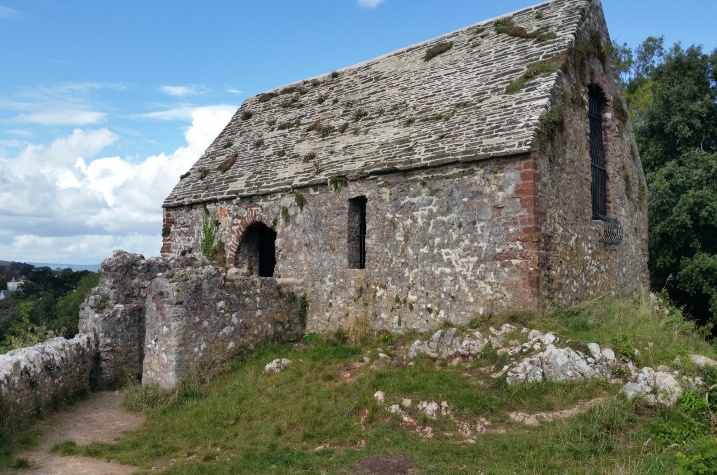
We parked the car near Torre Station, crossing the road and taking the footpath up through the woods to Chapel Hill. It was a beautiful sunny afternoon and at the top several people were visiting the chapel. It was built in the 13th century, thought to be on the site of a vision of the virgin Mary, and it is also thought that monks from Torre Abbey built the chapel, one monk coming each day to do this.
In the early 19th century the Catholic philanthropist, Marchioness of Bute, had a cross placed on the roof. However, this was removed when builders repaired the roof in recent times.
The chapel is a listed building and there is much local interest in this building.
Jennifer Webber
**********
Contributions from Creative Writing Group
‘It started like this’ – by Kathryn Bestwick
Ug was crouching in the chilly damp cave he called home. He’d definitely heard something. Could be anything. Could be something after their food stash. He’d left a pile of raw mammoth by the entrance. Could be something after that. All sorts going on since that other lot moved in. Used to be ok up here in the rocks. Decent neanderthal neighbourhood. Now and again making his way with the other strong males down for the hunting. Maybe a bit of pillaging and ravishing if he wasn’t too tired after the kill. Those mammoths took some bringing down and almost as much effort chewing it afterwards. When the deep waters came two moons ago that valley lot decided to move up the mountain. It was never going to work. They had no idea. They didn’t even eat mammoth. Who eats stuff growing out of the ground, for god’s sake? One lot of deep water and all their food supply was washed away. Take more than a bit of water to wash a herd of mammoths away. The meat eaters food supply was endless. Plant eaters were doomed. It’d never catch on. Mind you, he’d done alright out of their disaster. Got himself a female in exchange for sorting out a couple of empty caves for the grass munchers. She was hard work though. He had no inkling about what she was saying most of the time but that never stopped her. God, she had a mouth on her! He was doing his best to get her to communicate like him. He pointed at stuff and gestured and got her to make the same sounds but there was an awful lot of moaning and complaining in between. He didn’t need to speak her language to understand that. Ug checked one more time but couldn’t see where the noise outside had come from. There was no light in the sky yet. He turned to feel his way back to his sleeping place, but his woman was awake now and sure enough she was moaning again. God, she got on his nerves sometimes.
“Cold”
She said and Ug sighed. Yes. He knew it was cold. He was cold. Everybody was cold. It was a cave on the side of a mountain.
“Food”
She said and Ug gritted his teeth and clenched his fists. She was a good-looking female, young and strong but nag, nag, nag. He thought they’d said her name was something like Ka so that’s what he called her. He’d had to carry her up to his cave. It wasn’t hard. He’d carried heavier carcasses back up to his mountain lair. She was managing to catch on to the odd word if he said it often enough. Turned out he seemed to say food and cold a lot!
“Cold. Food.”
Ka said again and he snapped:
“I’m trying my best. You’re doing my head in, Ka. Moan, moan, moan.”
He shook his tired head in the darkness hoping she’d get tired and give it a rest soon. He’d pushed as much straw as he could away from the cave’s mouth to give them somewhere dry to sleep on, but it was never enough.
“Moan. Moan. Moan.”
Repeated Ka.
Ug tightened his jaw and drew in his breath. Why did he have to open his big mouth.
“Cold. Food. Moan.”
Ka said. Great. He’d given her another complaining word. He’d have to be very careful in future watching what came out of his mouth.
“Cold. Food. Moan.”
Ka kept saying. Ug picked up a small rock and squeezed it tight to stop himself from giving her a whack. She didn’t stop. He brought his fist up but struck out to the side, striking his hand with the stone in it against the rough wall, beating out his irritation to the rhythm of Ka’s complaints. A sharp bright light suddenly flared off the stone. That shut her up. That shut both of them up. Ka moved further back into the cave, uncertain and afraid. But Ug wanted to see the bright light again, so he repeated bashing the stone against the cave wall until, sure enough, there it was again. A quick burst of light like neither of them had ever seen before. Brighter than the start of day light. Whiter. Brighter. But gone so soon. Ug couldn’t stop himself now. He just kept on banging the stone until more bright white sparks flew out. Some landed on the dried straw at his feet. That sent him stumbling to the back of the cave along with his woman. The shower of white lights made the straw turn into a grey mist, then a dark fog, then it hissed and crackled before bursting forth with flickering licking yellows and reds. The fog disappeared and they could see clearly now, better than the start of day. Ug lifted his head and sniffed the air. He looked at Ka. She looked back at him and sniffed, too. What was that great smell? It couldn’t have been the grey fog. That had gone now. What was it? They looked at each other then back towards the leaping lights at the cave entrance. The mammoth meat was sizzling next to the blackened straw. Ug didn’t know what was going on, but it smelled so good. He wanted to taste that meat now. He crawled over and went to reach for it. The searing pain was like nothing he had ever experienced before. He almost cursed but remembered how Ka repeated almost everything he said.
“Fu …!”
He exclaimed then as the hurt seemed to get worse:
“Aye! Aye! Aye!”
He cried out. His woman came forward hearing his distress instinctively wanting to comfort him but not knowing the cause of his pain. In her attempt to make sense of the situation she echoed her man’s utterances:
“Fu aye? Fu aye?”
And he screamed with the pain of his scalded hand:
“Aaaggghhh!”
And Ka repeated:
“Fu ay aagh? Fu ay aagh?”
“Fi-yah?”
She asked.
Ug had no idea what she was saying but she wrapped her arms around as much of his burly hairy frame as she could and rocked him gently whispering back to him:
“Fire. Fire”
And Ug forgot about the noise he’d heard, forgot even about the sizzling mammoth steaks and enjoyed just being held against her soft and now warm body. Whatever this fire word meant he knew he was going to like it.
‘Rosemary for Remembrance’ by Betty Harcombe
I step through the creaking door of memory into Dad's first garden, a garden created from a wilderness of weeds, nettles, rubbish and rubble as a way of coping, I now believe, after five long years as a Prisoner of War. It was his solace and therapy for the lost five years that were never ever spoken about.
It was a mini-eco system with every bird, insect, plant, vegetable, flower and small animal playing its part. Centipedes marched along like Roman Legionaires, worms wriggled in and out of newly turned earth, busy ants formed orderly queues like housewives for rationed bread, angry bluebottles invaded the house, drunken wasps landed on windowsill and friendly headed for the roses like guided missiles. The only war Dad waged was against moles on the lawn, aphids, slugs and greenfly.
Each season brought its own delights, bright yellow flower spikes of Mahonia on colourless January days, the oddly shaped petals of Witchhazel and the multi-coloured leaves of a Eunonymous busy peeking through the snow. The shy, dropping heads of Snowdrops heralded the end of Winter and the Daffodils were a sure sign of Spring.
Dad toiled and nurtured, encouraging early pink Rhododendrons, pink and white Heather, yellow Broom, Hawthorn with its mass of small white flowers and pastel Sweetpeas to appear at the right time. Along the edge of the path a regal profusion of purple Pansies lorded it over tall, blue Lupins, sweet smelling Roses, Lily of the Val!ey, Love in a Must and Dahlias with their tightly-packed petals. Honeysuckle had pride of place under the Windows of the house.
The vegetable garden was furthest from the house, its boundary was the banks of a little stream. He grew potatoes with names like Duke of York, Arran Pilot and Kerr's Pinks, Ailsa Craig onions, neat rows of cabbages, lettuces, cauliflowers, beans, peas and soft fruits, all bringing colour and variety into the garden. In the greenhouse he nursed the tomatoes, watching them turn from green to red and even tried to grow grapes.
I remember the taste of peas straight from the pod, the silky feel and smell of the tomatoes and the taste of the first, tiny, new potatoes boiled in their skins then smothered in butter. On a drowsy Summer's day you could feel and hear things growing around you, seeds popping, bees humming, birds chirping, butterflies fluttering, the occasional burp of a frog and the gentle tinkle of water flowing over small pebbles, while lying on the lawn, young and carefree.
Betty Harcombe
**********
By Cookery for Entertainment Group
Apples! Apples! Apples!
There has been a glut of apples this year and many people with apple trees, not liking to waste food, are desperate to unload some of their unwanted fruit on to you.
Unfortunately, because of the weather, those whose trees are ornamental rather than purposeful, have probably found that much of their fruit is very small. If you are lucky enough to know someone with an apple press, this produce can be turned into apple juice.
However, if you have or are the recipient of viable apples and as the weather appears to be unsettled, now is the time to make use of them.
Freezing them is a solution if you have little time now. Simply peel, core and slice the apples and toss them in a solution of lemon juice and water. Pat dry and then spread on a flat parchment lined baking tin and freeze until solid. Bag up for use later in pies, apple cakes, crumbles, smoothies etc.
I like to stew some every few days for breakfast. Sliced apples, sugar to taste and one’s spice of choice. I like cloves, about four. Others prefer cinnamon. Serve with yoghurt. Yum!
One can make apple jam but it isn’t my favourite. However, if you want to try it, the BBC Good Food website has some recipes.
I used to make crab apple jelly at one time as it is a lovely clear pinky red colour and makes great Christmas presents. I don’t anymore as collecting crab apples is no longer one of my skill sets.
Apples are an ingredient in many chutneys if you’re feeling that sweet dishes are not for you.

My favourite is Delia Smith’s Spiced Plum Chutney, which as well as tasting great, has the advantage of using up quite a lot of apples. The recipe can be found online and if you are unsure how to make chutney there are videos on YouTube to help. The jars must be sterilised and the chutney kept in a dark place. It won’t be ready to eat for three months so if you are thinking of Christmas presents better start soon.
Talking of Christmas, homemade mincemeat also uses up apples, tastes great and will keep indefinitely. I usually make some every two or three years. Again see online for recipes. I wouldn’t use frozen apples for this though.
The glut of apples meant that the Cookery Group had an impromptu ‘Apple Extravaganza Lunch,‘ recently where we all brought apple dishes.
We began with an Apple and Roquefort puff pastry dish and followed it with roast chicken thighs with Apple and Goat’s Cheese Salad.
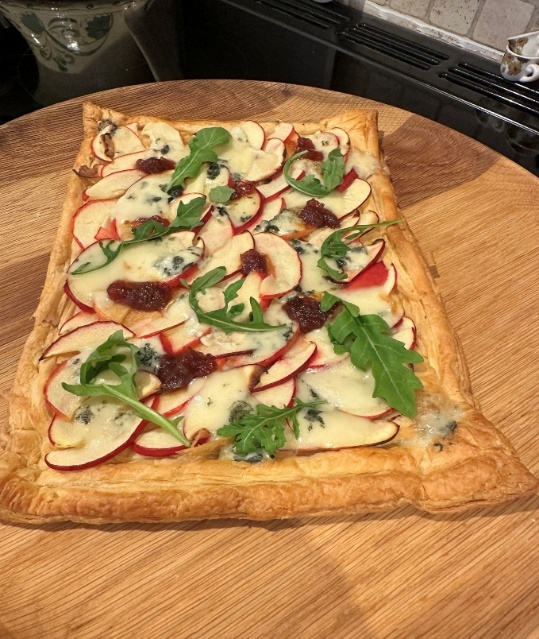
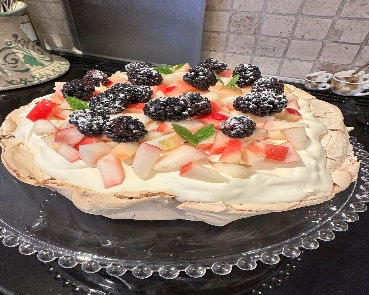
We ended with various apple pies and an Apple Pavlova.
It was a lovely occasion but we were all very full by the end even though we left plenty of time between courses.
I realise that cooking is not to everyone’s taste, especially if like me, you have been in charge of the kitchen for most of your lifetime.
Indeed, I myself have handed over ordinary meal preparation over to my husband but I am still in charge of baking any meal where there is more than two of us.
Getting together with others over a meal is one of the great pleasures of life so don’t be put off by ‘ I can’t cook.’
Eating your lunch or supper with others can only be beneficial and the meal doesn’t have to be fancy. Give it a go!
Gina Royle - Group Leader
**********
Freya's Well-Being Tips
MY FAVOURITE QUOTE THIS AUTUMN
‘KIss each joy as it flies and live in eternity’s sunrise’ William Blake.
Recipes for Well Being
Sweet treat This couldn't be simpler, is healthy, and uses this autumn's abundance of fruit... Simmer 500 g of peeled roughly chopped eating apples or pears till soft in a little water. Whizz them in a food processor or blender. Melt 220g of 70% broken up dark chocolate in a basin over a little boiling water. Stir the chocolate into the apple puree thoroughly. Refrigerate. That's it. Its like a chocolate mousse. Nice with some greek yogurt (or cream🙄) .…
Dynamo Greens from Dale Pinnock’s book ‘The Medicinal Chef’ (slightly adapted recipe). Fry finely chopped leek, garlic and chilli (to taste) gently in olive oil for a few mins. Add 2 handfuls of shredded greens of any sort and cook gently and briefly till softened. Add a tbsp soy sauce, tbsp honey, 2tbsp crunchy peanut butter, half tsp Chinese five spice, and salt. Stir well, check taste and adjust as wanted, and serve immediately.
Non-toxic Clean up
Let's start with toilets 🤣 Bleaches and toilet cleaners are killing our rivers and seas. Keep your toilet perfectly clean with this: Nancy Birtwhistle calls it ‘Toilet Magic’ in her book ‘Clean and Green’. Mix 200g Citric acid (non toxic but powerful) in 150ml just boiled water, stir to dissolve, add 20ml Ecover dishwash liquid and 20 drops of tea tree oil. Shake or whisk. Let it cool. Then put in a spray bottle. Spray around the bowl as usual. It lasts ages. B&Q now sell Citric acid in their cleaning aisle and Holland Barrett have the oil. Or shop online.
Check out our ‘Tutorial Programme: Email Freya Hartley
**********
Train Adventures – Trip to Exmouth

At Torquay station ten of us gathered bright and early for Tammy's train trip to Exmouth And what a morning, the sun already warm , the blue skies promising a perfect day to come .
Once past Newton Abbot a water world opened up as the Teign at full tide caught the light, reflecting trees and banks on its mirror glass surface. Under Shaldon bridge and on towards the sea where early walkers strode along the sea wall, then Dawlish where bathers were enjoying a dip.
Now the River Exe near the end of its long journey spread out towards Exmouth where it escaped into the sea. Then stately Powderham where fallow deer grazed beneath trees and fields of golden crops lit up the rolling hills beyond.
At Exeter we began our journey back down the Exe looking across the river to the distance we had travelled. Then the seaside town of Exmouth where we sat in the pleasant centre enjoying coffee before strolling to the seafront past the beautiful row of white houses that stand out so clearly on a sunny day from Torquay.

Later we had lunch at the quay then off we went to board a pleasure boat for a leisurely trip on the Exe estuary. The river had started to recede and banks of mud and sand appeared. We soon realised what a skilled job it was to manoeuvre the boat in shallow waters which were sometimes a mere metre in depth beneath us . How different it was from our winter trip when hundreds of migrating birds were there to feed on cockles and mussels and all the rich pickings. Now birds were scarce , a few oystercatchers, swans a couple of white egrets, some black-backed gulls and herring gulls.
The views in every direction were beautiful. Brunel’s pumping station stood out against the gentle village background Here and there ghostly remains of shipwrecks half buried in the sand and close to shore a flotilla of yachts moored for summer use. We glided for over an hour, some passengers having cream teas while others enjoying a cuppa served by the crew.
Our boat trip ended with a cruise along the 2 1/2 mile beach front , we all agreed what a lovely time we had enjoyed.
Then our journey in reverse, from the comfort of the train, the Exe, the sea and the Teign
A wonderful day, thank you Tammy
Carol Woodford
**********
Knitting Group
Colourful samples from the Knitting Group


**********
The Long Haul by Paul Dennison
Paul is raising funds for Parkinsons by selling his poetry books. He is passionate about raising awareness of this illness. Poetry has become a powerful tool for raising awareness about Parkinsons. Through the creative expression of personal experiences, poems can shed light on the challenges faced by individuals with Parkinsons, offering hope, strength, and a sense of community.
My body is failing and no longer holds a charge
I can't manage a full day, where before I gave it large
My health issues are draining my batteries too quickly
I can feel my energy fade and I become more prickly
My cognitive abilities are altering
Not just my movement, my brain is also faltering
Words leave me tongue tied and, in a jumble,
My voice soft, incoherent, as I start to mumble
Things seem to be changing and as a rule
I generate more saliva as I dribble and drool
I have to sleep on my side which is easy for some folk
If I sleep on my back, it’s so easy to choke
My mouth is so tender and dry in the morning
Then there’s weird smell of burning this comes without warning
My food I have to be careful not to eat too fast
And slip through the gaps in my teeth which are vast
My eyes see the words on the page I've just penned
Then my voice delivers them all mixed up, this is a new trend
Like a game of cards, this disease is showing more of its hand
So, I've retired from work, so I can concentrate on my dreams as planned
Fatigue is a problem that can no longer be contained
So, I have to spend more time resting, because I feel drained
Despite all the above, I’m positive, coping and remain strong
For those struggling, please talk, don’t pretend nothing’s wrong
Parkinson’s is relentless, unforgiving, physically and mentally draining
Difficult to describe how we feel, just explaining
For all the carers & Volunteers that look after us all
A heartfelt thank you, it’s appreciated you being there for the long haul.
Paul Dennison -Member
Google ‘Raising Awareness through Parkinsons Poetry’ to view more inspiring examples.
Editor.
**********
Our Committee (March 2025)
(Contact information on the Contact page on our website)









Message from Chair: My priorities for the coming year are:
- To grow the membership and increase the diversity of groups
- To extend our u3a’s interaction with the wider Torbay community
- To work more closely with other u3as in the Bay.
The Committee is also looking for members to fill the roles of Business Secretary, Audio/Visual Manager for Speaker Meetings, Community Liaison Officer, and helpers with refreshments. Please contact the Chair to find out more. It’s an exciting time to join our leadership team!
**********
About Torbay u3a
Some information about us for any non-members reading this.
The Torbay u3a has over fifty special interest groups run by members for members. Check out our website for details including contact details for the different groups, or visit our public Facebook page
Membership is £16pa, and members can join as many groups as they wish. Most groups are free apart from members sharing venue hire fees when appropriate. Many groups meet in members homes at no cost – an important feature of u3as across the country.
The diversity of groups is huge and we’re always looking for members to initiate and lead new groups. Contact the Chair or the Groups Coordinator if you have an idea for a new group.
New to u3a? You can try out a group (or groups) before deciding to join, or come to one of our monthly ‘speaker meetings’ held on the second Wednesday of the month at the Central Church in Torquay.
Members from other u3as can attend up to two of our group meetings for the nominal fee of £1, but always check with the relevant Group Leader to check availability or ‘last minute’ changes.
Join Torbay u3a today!
**********
Our Torbay u3a Facebook News
We now have a full Facebook presence.
We have a PRIVATE GROUP FOR MEMBERS only...67 of us so far. News is posted frequently, so you can keep right up to date with all that is happening, especially if you allow notifications of posts.. Members are commenting on the posts and we also encourage you all to post your news and photos and your u3a experiences yourselves. The group is beginning to come alive even though it is only three weeks since its launch. Join up and see for yourself! Karen Daly, our Membership Secretary sent out a link on 14th September but you can just search facebook for Torbay u3a members group. Or come along to our Techy Table at the next Speaker meeting and get some help.
We also have a PAGE OPEN TO THE PUBLIC for publicity, where we can post our news and hope people want to join in. They can message us direct from this page and we can post on community Facebook groups from it so Torbay u3a gets more and more known.
**********
Contributions from the Art Group
‘This is a very easy-going group, very welcoming, for anyone who would like to spend some time drawing or painting, whether beginning or experienced. I personally love the hush that descends about 10.15 when we are all concentrating. At coffee time we have the chance to look at what we are all doing, it is all so different and always interesting.’
Member.


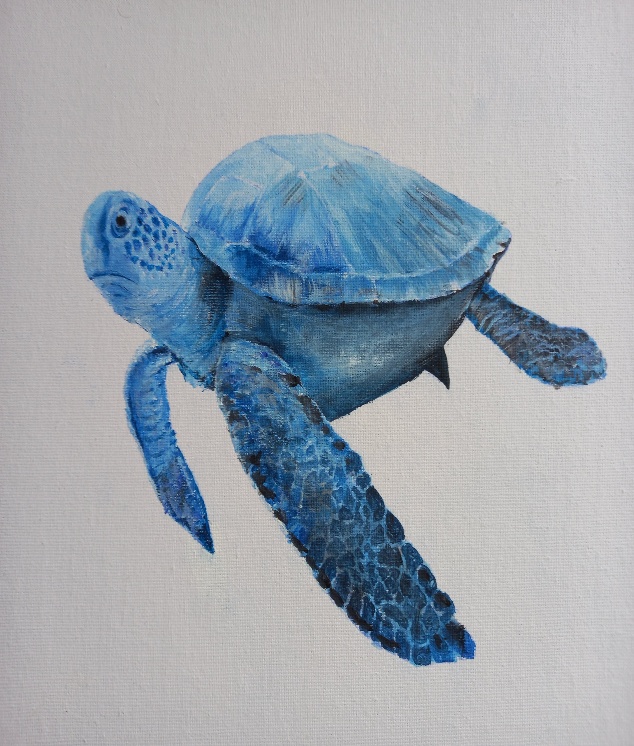
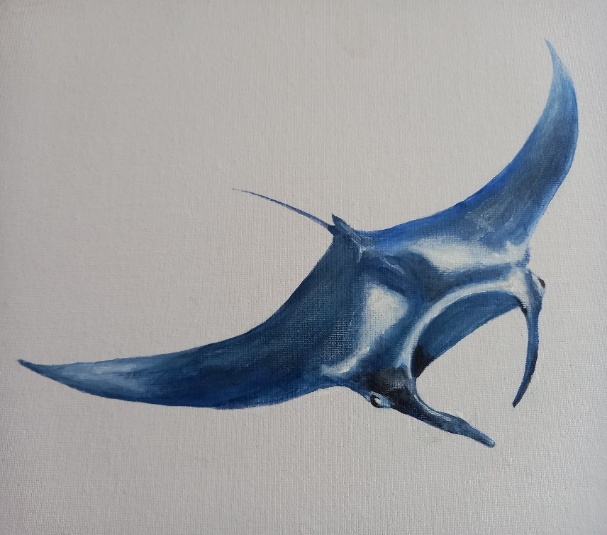
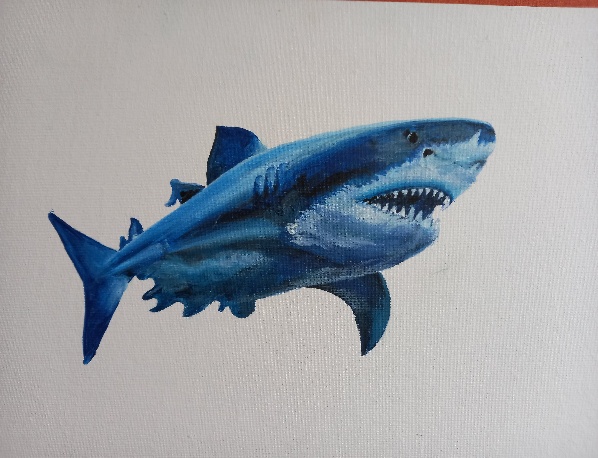
‘Sea Creatures’ by Bryan Hill
More Paintings can be found on the Arts Group page
**********
Book Group No. 3
3rd Monday of the month at 2pm
This book group started in July, and after a first get-together we chose to read Colm Tóibín’s Long Island, which continues the story of his award-winning novel, Brooklyn.
Long Island
Our first choice in Long Island was interesting and readable. There are many reviews of this book online and elsewhere, so I won’t repeat what has already been said. Our discussion of the book was personal as well as being an appreciation of the plot, the relationships, the style and the choice of place. The book follows the story of the main characters in the previous novel, Brooklyn, where Eilis and Tony, now married with two teenage children, live in Long Island in a cul de sac of four houses, surrounded by Tony’s extended Italian family. Eilis is somewhat isolated in this close-knit family group.
In the first pages, a shocking incident occurs, where a man knocks on Eilis’s door to say that his wife is expecting Tony’s baby, and that when it is born, he will bring it to the house and leave it on the doorstep.
There is much discussion between Eilis and Tony and within the family, and Eilis decides to go back to Enniscorthy in her native Northern Ireland to celebrate h er mother’s the 80th birthday. Eilis and Tony’s children - Rosella, who is months away from going to college at Fordham University; and Larry, a high school student - are to follow once the Summer holidays start.
The main focus of the story from then on is in Enniscorthy, which is Colm Tóibín’s birthplace and family home. It is a community and society which he knows well, and he writes with authenticity about the characters and setting. In the story Eilis meets Jim Farrell, the man she loved and left behind to return to Brooklyn where she was already married to Tony. Jim never married, but he is now in a secret relationship with Eilis’s childhood friend, Nancy Sheridan. So much of the lives of the characters consist of hopes and plans which remain hidden from their families and friends. Jim meets Eilis again and has secret hopes of returning with her to Long Island. Nancy hopes to build a bungalow and a life with Jim Farrell once they marry, but she does not want to overshadow her daughter’s wedding plans by announcing the couple’s engagement too soon. Life seems to be lived like a rather elaborate poker game. The events are uninteresting in themselves, but the characters’ secret hopes and plans add suspense.
It was interesting to hear our various reactions to the story and the setting. There was a recurrent theme of belonging. Eilis had married into a close-knit Italian family and felt like an outsider. Tony’s illegitimate child was to be rejected and left abandoned on Tony and Eilis’ doorstep, and further rejected by Eilis. One member of our group grew up in a large Irish family in the North of England, and she shared her memories and insights from that perspective. I spent my childhood in America in a family of first-generation immigrants from the UK. I could relate to Rosella and Larry visiting the home of their mother in Enniscorthy and discovering her family and life in the community there.
Our overall score : 7 out of 10.
Bel Canto
Our next choice was Bel Canto by Ann Patchett, who is an award-winning author of many bestselling books: The Dutch House, State of Wonder, Run, Tom Lake and others. Bel Canto is a popular choice for book club reads.
The synopsis of the story was what had captured my interest:
This book tells a gripping story set at a party in an unnamed South American country. A renowned opera singer mesmerizes guests, but chaos ensues when terrorists take them hostage. In this life-threatening situation, unexpected bonds form among hostages and captors, leading to moments of beauty amid fear.
I loved this book. The writing is beautiful and illustrates over and over again the power of music to elevate the spirit and overcome negativity.
The story is very loosely based on an actual event. One account of the book says:
The true incident took place in December 1996, when a terrorist organization called Tupac Amaru took over the Japanese embassy in Lima, Peru. Ann tells us "That event had so many elements that were compelling to me - confinement, survival, the construction of a makeshift family of sorts. For a long time, I'd wanted to find a way to experience the things I read about in the paper, to grieve for disasters that had no immediate effect on my life. Turning a tragedy which I knew nothing about into this novel was part of that process."
The story is mostly pure fantasy. One review says: “Bel Canto treats Latin America as an exotic backdrop, not a real place”. The story is beautiful, both in the writing and in the way the story leaves behind the chaos and fear of a hostage situation. Roxanne Coss a renowned opera singer, and 52 men are held captive by a members of a terrorist organisation led by several Generals and a group of very young boys (two of whom turn out to be girls in disguise). During the 4 months that the hostages are held captive, relationships develop, love is declared, amazing talents emerge, hearts soften, and guns are left to one side while young terrorists and Generals sit enthralled in front of the TV or delight in the unfamiliar luxury of the mansion where the plot unfolds.
The author, in an annotated version of her novel published in 2024, says that the main character, Roxanne, is named after the heroine of the famous play Cyrano de Bergerac. In the play, Cyrano is an unattractive poet in love with Roxanne who helps a young suitor win her heart by making his declaration of love for him. The Cyrano story is reflected in a declaration of love by one of the Russian diplomats to the beautiful Roxanne, through the intermediary of the amazing Gen Watanabe, who acts as interpreter between the many nationalities present. The story doesn’t end well – we can guess that from the way the story unfolds, but there is a wedding at the very end, to soften the impact of the tragedy.
Our overall score: 9 out of 10
We have chosen Barbara Kingsolver’s The Bean Trees as our next book, to be discussed on 15th September.
There is space in our group for more members. Even if, like me, you have never been to a book group before, do get in touch with To email Glynis Greening our group leader if you would like to join us.
**********
Ancestors - the Torbay u3a Family History Group
We all have them and whether you regard them as family history, or ghosts from the past, they do exist. Two years ago, I started a Torbay u3a family history group, running it from my house in Magdalene Road.
With modern innovations and techniques it is becoming easier to find your family roots. DNA profiling is now very common and your Genome can be obtained from saliva (just like of the detective programs you see on TV). The use of AI promises to be another useful tool in searching one’s history.

Our membership has a core group of 8, others join in when it doesn’t clash with other commitments. Some people join for a short period of time because they have a specific family member who may have done something heroic, sometimes it’s to check up whether the second cousin in Australia really did descend from the convicts. My own contribution to that Victorian generation only got as far as a prison hulk in Portsmouth (poaching in the New Forest)
For interest to prospective participants, exploring one’s DNA can produce unexpected results (some would say consequences) and during the festive period offers of reduced cost testing abound. Depending on your specifics, Ancestry, My Heritage and Find My Past are three which can be explored. My daughter and I undertook testing and it revealed I am her father (50% genomes) and she is allergic to coriander, something she has always hated!
If you have an occasional interest or are just interested to learn about this interesting hobby, please just contact me and I will send you address etc. Come along with your laptop, I Pad or phone and If you are a member of Ancestry etc don’t forget your log in details . No charge but 50p contribution for tea and coffee appreciated.
Regards Chris Price
email Chris Price
**********
Interview with Peter Osborn by John Hough
This audio interview is an experiment for both Peter Osborn and myself. It’s the first time I’ve tried this and I’m using software on my laptop that I’ve never used before. It’s also new for our Webmaster, Bob, taking my output, an MP4 audio file, and testing whether it can be incorporated in the Quarterly. Maybe a member reading this is familiar with such software, or would like to develop their skills in the area. If so, I’d very much like to hear from you.
The idea for the interview came to me after speaking with Peter at a ‘Practical Gardening Group’ meeting. Peter was telling me how he joined the Royal Navy, almost by accident, at 16 years old. He served over 20 years in the Navy, retiring when he was 40. I thought this would be an interesting story to share with members.
Please let me know how you find this initiative and whether we should repeat it in future issues of the Quarterly. One of the advantages of the current format of the Quarterly is that members can skip over items that don’t interest them.
Synopsis of Peter’s time in the Navy
Joined in 1955 aged 16.
1st memorable experience on HMS Protector Trip to Antarctica via Bermuda, Panama Canal, Peru, Chile, Cape Horn and base in Falkland Islands. Sailed south to survey stations. Home via Tristan De Cunha, Cape Town, Ghana and Gibraltar aged 19yrs.
1962 HMS Manxman ran aground at Isle of Man on route to Singapore for 2yrs to patrol Indonesian/ Borneo conflict. Family there, son born there.
1965 HMS Tiger used for Harold Wilson, Ian Smith talk re Rhodesia.
1967 HMS London beautiful looking ship. Bicentennial anniversary of Capt. Cook landing in New Zealand. Also visited Tasmania and Australia. Home via West Indies. Away 13 months.
1976 HMS Norfolk. Except missiles testing. Based Toulon all summer.
**********
This is the third Torbay u3a Quarterly
It is intended to share information and ideas from Groups more widely with our u3a members – to promote discussion across our u3a. It can also be a Forum for members to share their ideas with other members. It is vital that you give us feedback. Do you support this initiative? What should be included?
Email The quarterly putting ‘Letters to the Editor’ in the subject line.
Letters will be published in the next Quarterly – at the discretion of the Quarterly editorial team.
The Quarterly may also be used to promote our u3a across the Torbay community. As such, it would be fantastic, to get letters describing what you get from our u3a. Think of it as giving your u3a a ‘review’.
We, the Editorial Team, look forward to hearing from you.
John Hough (editor), Kate Parsons, Glynis Greening